
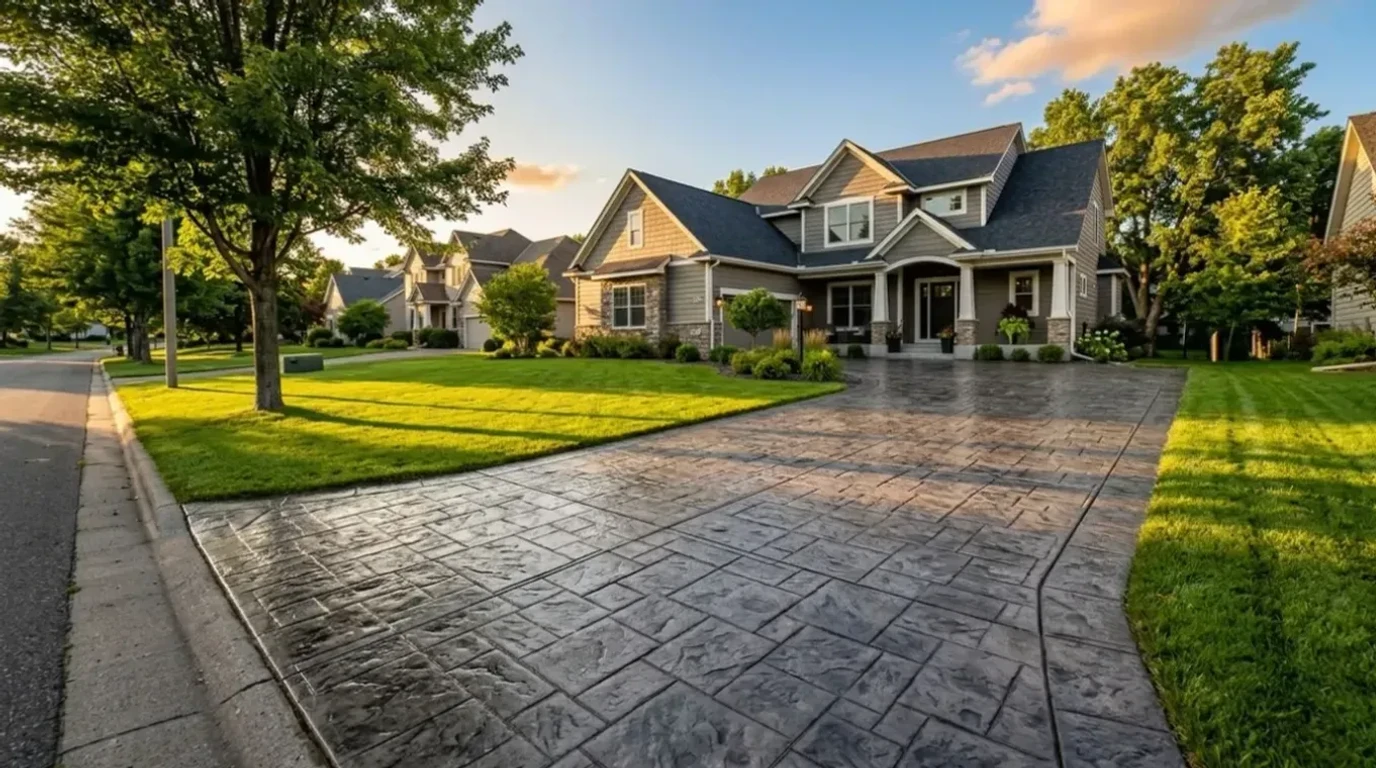
Concrete Driveways Built for Minnesota Freeze-Thaw Cycles
A cracked, settling driveway drags down the entire front of your house. Jensen Decorative Concrete pours residential driveways across the Twin Cities western suburbs — plain, stamped, or colored — with the thickness, air entrainment, and subgrade prep that Minnesota's climate demands.
What Goes Into a Concrete Driveway?
A concrete driveway is a reinforced slab poured at 4-6 inches thick over a compacted gravel subgrade. In Minnesota, the subgrade prep and concrete mix design matter as much as the pour itself — clay-heavy soils and freeze-thaw cycling punish shortcuts within the first few winters.
The process starts with demolition of the existing surface (if applicable), then excavation and grading. A compacted Class 5 gravel base goes down, forms are set, reinforcement is placed, and the concrete is poured, finished, and cut with control joints. Decorative options — stamping, color, exposed aggregate — happen during the finishing stage.
- Poured at 4-6 inches to handle vehicle loads and resist frost heave
- Air-entrained concrete mix resists internal freeze-thaw cracking
- Compacted gravel subgrade prevents settling and shifting on clay soils
- Control joints placed strategically to direct any cracking to predetermined lines
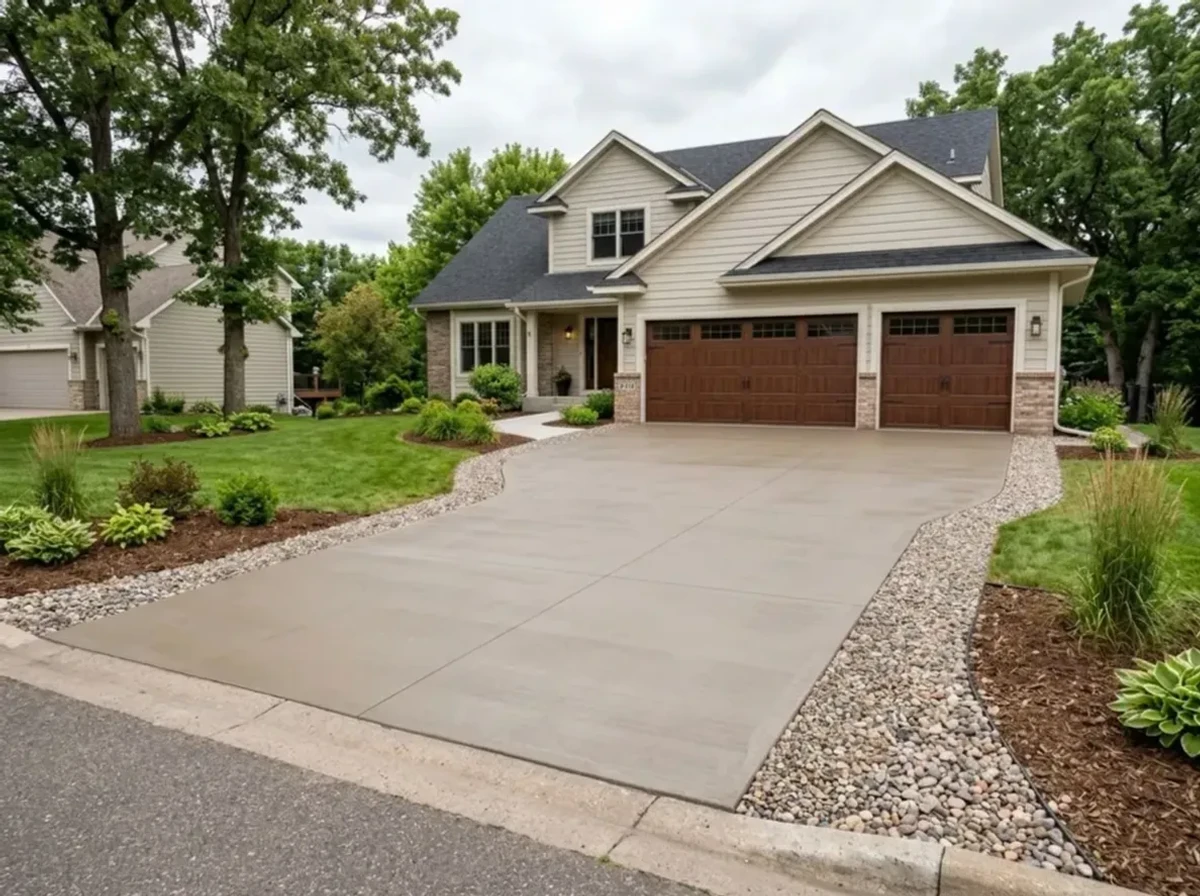
Concrete Driveway Finish Catalog
Every driveway starts with the same structural foundation — the finish is where you make it yours.
Broom Finish (Standard)
The classic, cost-effective option with a textured surface that provides excellent traction.
- Standard broom finish
- Medium broom texture
- Swirl / fan broom pattern
Exposed Aggregate
Natural stone aggregate revealed by washing the surface before full cure. A durable, slip-resistant option.
- Pea gravel aggregate
- River rock aggregate
- Crushed granite aggregate
- Custom aggregate blends
Stamped Concrete
Patterned texture pressed into the wet surface. Replicates the look of stone, brick, or cobblestone.
- Ashlar Slate (full surface)
- Cobblestone
- Stamped border with broom-finish center
- Running Bond Brick
Colored Concrete
Integral pigment or surface-applied color hardener. Smooth or broom finish with a uniform, non-gray tone.
- Charcoal
- Sandstone / Buff
- Slate Gray
- Custom integral color
Decorative Borders
Stamped or colored borders framing a plain center. Maximum visual impact at moderate cost.
- Stamped border (6-12" band)
- Contrasting color band
- Exposed aggregate border with broom center
Not Sure Which Finish Fits Your Budget?
Derek provides options at different price points during every consultation. A broom-finish driveway with a stamped border often delivers 80% of the visual impact at half the cost of full-surface stamping.
Book Free ConsultationDriveway Projects
Browse recent driveway installations across the Twin Cities western suburbs.
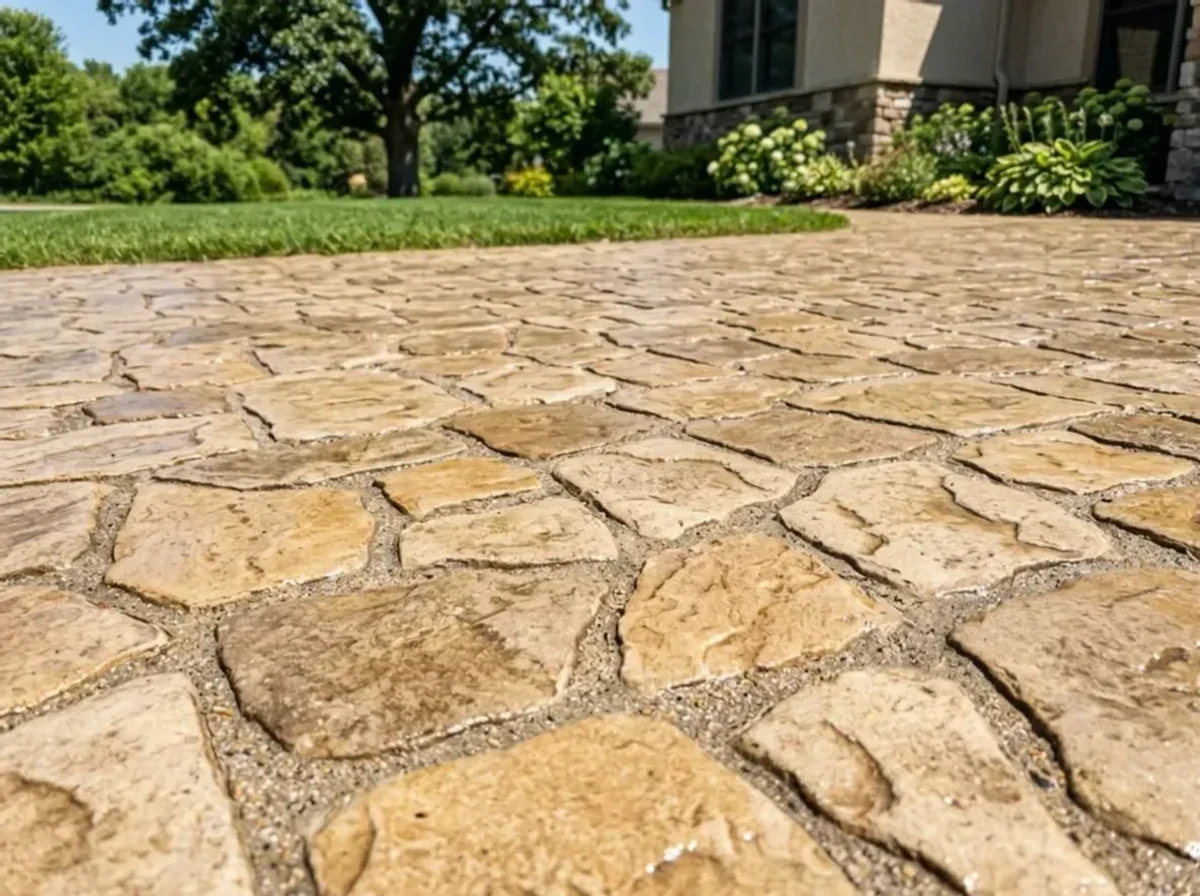
Stamped Cobblestone
Wayzata, MN
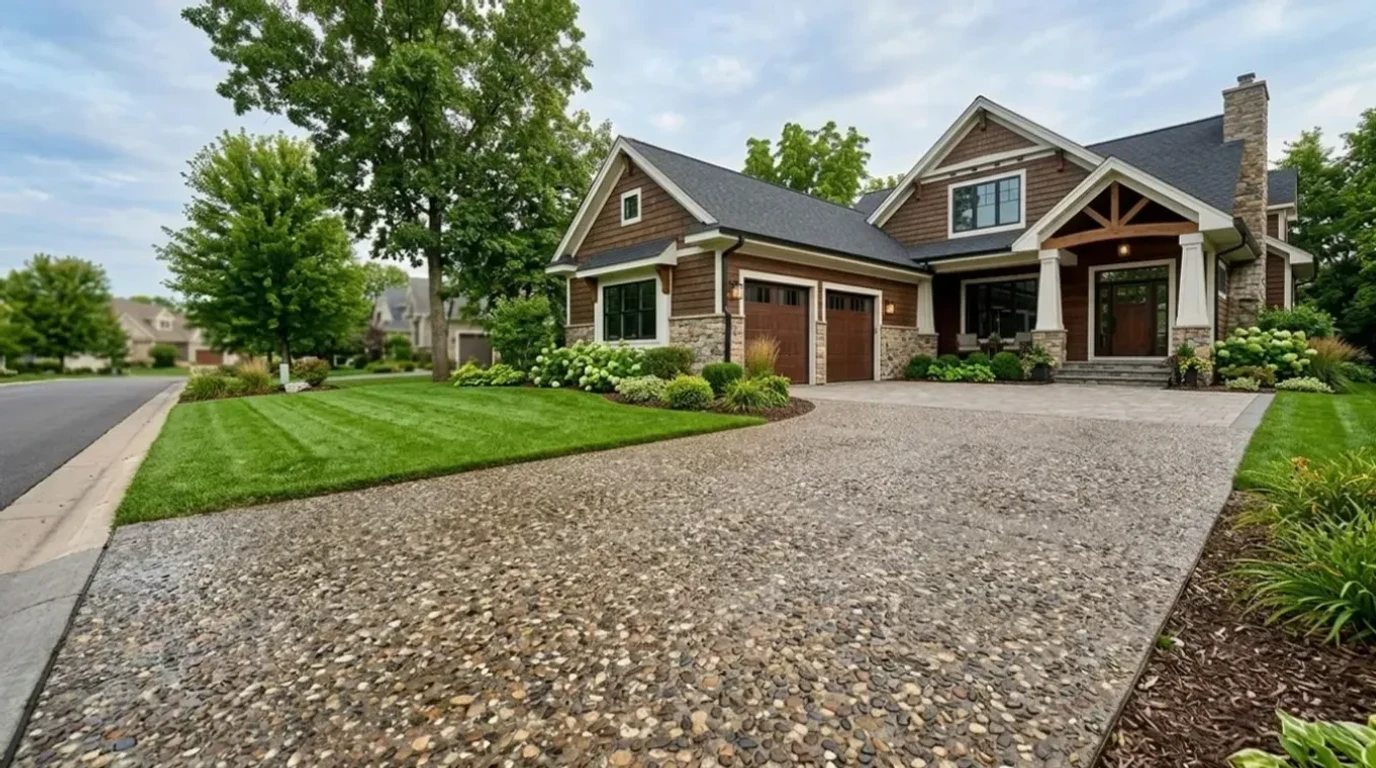
Exposed Aggregate
Eden Prairie, MN
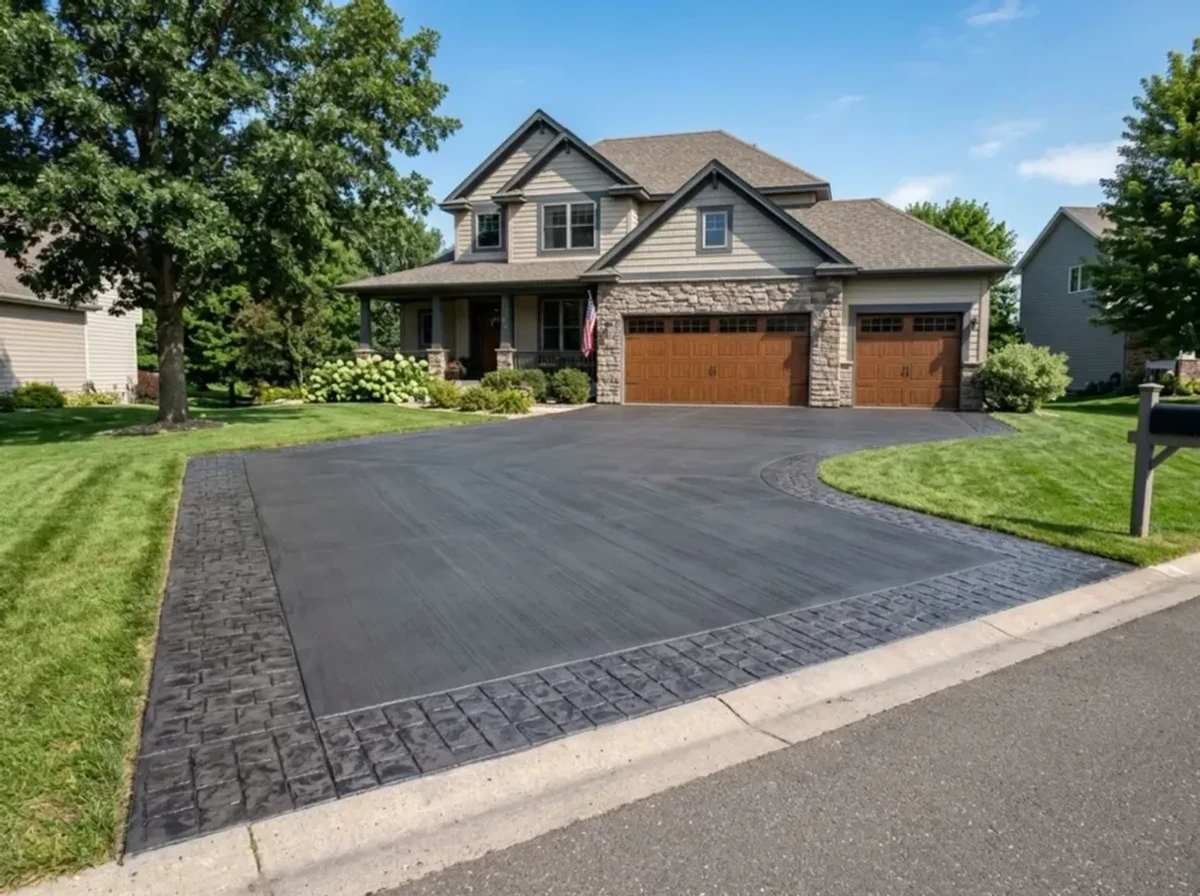
Colored with Stamped Border
Chanhassen, MN
Concrete Driveway Applications
Not every driveway is a straight rectangle — here's what Jensen Decorative Concrete builds.
Standard Driveways
A straight or gently curved driveway from the street to the garage. Most Twin Cities homes need a two-car-width slab (16-20 feet wide) poured at 5-6 inches thick. Proper grade ensures water runs toward the street, not into the garage.
Popular options: Broom finish, charcoal integral color, stamped border
Circular Driveways
Common on larger lots in Orono, Wayzata, and Shorewood where setbacks allow the loop. Circular driveways require careful forming for consistent curves and proper grade throughout. Stamped or exposed aggregate finishes give the driveway the presence that a plain slab can't deliver on a high-end property.
Popular options: Ashlar Slate stamp, exposed aggregate, cobblestone border
Driveway Extensions & Widenings
Adding 4-6 feet to one side of an existing driveway creates room for a third car, a basketball hoop, or easier turnaround space. The new section can match the existing concrete or use a contrasting finish to create a visual boundary.
Popular options: Matching broom finish, contrasting color band at the seam
Aprons & Street Transitions
The apron is the section between the street and the sidewalk. It takes the most abuse — snowplows, salt, and the heaviest vehicle loads at the steepest grade. A thicker pour (6 inches) with reinforced edges extends the apron's life.
Popular options: Thickened-edge pour, broom finish, matching driveway color
Turnarounds & Parking Pads
A dedicated turnaround or extra parking pad keeps guests off the lawn and gives you room to maneuver without backing into the street. These smaller pours (200-400 square feet) are a cost-effective addition that improves daily function.
Popular options: Broom finish, matching driveway color, exposed aggregate
Concrete vs. Asphalt vs. Pavers
| Feature | Concrete | Asphalt | Pavers |
|---|---|---|---|
| Lifespan | 25-30+ years | 15-20 years | 25-50 years |
| Maintenance | Reseal every 2-3 yrs (decorative) | Sealcoat every 3-5 yrs | Re-leveling, weed control |
| Install Time | 2-4 days | 1-2 days | 5-10 days |
| Cost | $$ | $ | $$$ |
Concrete driveways cost more than asphalt upfront but last significantly longer — and they don't soften in summer heat or develop ruts under tire traffic. For homeowners planning to stay 10+ years, concrete delivers lower total cost of ownership.
Our Driveway Installation Process
Free On-Site Consultation
Derek visits your property to evaluate the existing surface, discuss finish options at multiple price points, and take measurements.
Demolition & Excavation
Remove the existing surface (if applicable), excavate to stable material, and grade for proper drainage away from the garage.
Subgrade Prep & Forming
Compact Class 5 gravel base in lifts, set forms to grade, and place reinforcement — fiber mesh, rebar, or wire mesh.
Pour, Finish & Cure
Pour air-entrained concrete at 4-6 inches, apply chosen finish (stamp, color, broom), cut control joints, and allow proper curing time.
Driveway Maintenance
Concrete driveways are low-maintenance, but a few seasonal practices extend their life in Minnesota's climate.
Use the Right De-Icer (or None at All the First Year)
New concrete needs its first full winter to finish curing. Skip de-icers entirely during that initial season — use sand for traction instead. After year one, calcium chloride is the safest chemical option. Avoid sodium chloride (rock salt), which accelerates surface scaling.
Seal Decorative Driveways Every 2-3 Years
Plain broom-finish concrete doesn't require sealing, though a penetrating sealer adds protection. Stamped and colored driveways do need resealing every 2-3 years to maintain color and surface integrity.
Address Cracks Before Winter
Water enters cracks, freezes, expands, and widens them — every single winter. A tube of concrete caulk applied in early fall keeps hairline cracks from becoming structural failures by spring.
Keep the Surface Clean
Oil drips from vehicles, leaf tannins, and standing water can stain and degrade a driveway over time. A garden hose and degreaser handle most stains. Avoid pressure washing above 2,000 PSI.
Why Jensen Decorative Concrete for Your Driveway
A driveway is the largest slab on most residential properties — and the most visible from the street.
Proper Subgrade Prep for Minnesota Soils
Clay-heavy soils across the western suburbs shift with moisture and frost. Derek's crew excavates to stable material, compacts in lifts, and places a Class 5 gravel base before any concrete is poured.
4-6 Inch Thickness, No Shortcuts
Derek pours at 5-6 inches for standard use and thickens edges and aprons where loads are heaviest. The extra inch of concrete and reinforcement costs a fraction of a premature replacement.
Decorative Options from the Same Crew
Derek's team handles both structural and decorative driveways in-house. A stamped border, exposed aggregate finish, or integral color is part of the same pour — not a separate trade.
Owner on Every Pour Day
Concrete is a one-shot material. Once it's placed, you can't undo mistakes. Derek is physically present for every pour, managing timing, finish quality, and joint placement.
Concrete Driveway FAQ
A properly poured concrete driveway lasts 25-30 years or longer in the Twin Cities area. The three biggest factors are slab thickness, air entrainment, and subgrade compaction. Minnesota's freeze-thaw cycles are hard on concrete, but a well-built slab with proper drainage handles them without structural failure. Decorative finishes may need resealing, but the underlying concrete stays sound for decades.
Concrete costs more upfront but lasts 10-15 years longer than asphalt. Asphalt softens in summer heat, develops ruts under parked vehicles, and needs sealcoating every 3-5 years. Concrete stays rigid in all temperatures and offers decorative finish options that asphalt can't match. The break-even point is around year 12-15 — after that, concrete is the cheaper option over total lifespan.
Standard residential driveways should be 4-6 inches thick. Derek typically pours at 5 inches minimum, with 6-inch thickened edges at the apron and along the sides. If you park heavy vehicles — boats, RVs, work trucks — 6 inches throughout is the safer specification. The subgrade matters equally: 4-6 inches of compacted Class 5 gravel beneath the slab.
Sodium chloride (rock salt) is the harshest common de-icer on concrete surfaces. It accelerates surface scaling — that flaky, pitting deterioration you see on older driveways. The damage is worse during the first winter when concrete is still curing. After year one, calcium chloride is the safest chemical option. Sand provides traction without any chemical risk.
Minor surface cracks and cosmetic spalling can be repaired with caulk, patching compounds, or a decorative overlay. If the slab has settled unevenly (one section 1/2 inch or more higher than an adjacent section), has widespread structural cracking, or is crumbling at the edges, full replacement is the more cost-effective long-term decision.
The concrete season in Minnesota runs roughly April through November, depending on temperatures. Ideal conditions are sustained air temperatures above 50 degrees Fahrenheit. May through October is the sweet spot — warm enough for proper curing, cool enough that the surface doesn't dry too fast. Derek schedules based on the forecast, not the calendar.
Concrete Driveway Installation Near You
Jensen Decorative Concrete serves homeowners across the Twin Cities western suburbs and surrounding communities.
A Driveway That Handles What Minnesota Throws at It
Derek evaluates your existing surface, discusses finish options at multiple price points, and provides a written estimate — all during a free on-site consultation.
Get Your Free EstimateQuality decorative concrete is just a call away.